
In 1978, after graduating from Wesleyan University with a bachelor degree in government (with many electives in English and religion), and resigning from my job as a teller at Connecticut Bank and Trust in Middletown, Connecticut, I whimsically decided to get on a bus to Atlanta, Georgia—so enamored was I of the Rev. Dr. Martin Luther King Jr. I left most of my small belongings in the basement of a house apartment in Middletown. When I arrived at the bus station near downtown Atlanta, I had a raggedy, brown suitcase packed with a few changes of clothing and $50 to my name! Wide-eyed and a tad nervous, I must’ve cut a lost and pathetic figure, for an adult male stranger informed me of vacant rooms at the Butler Street YMCA, which was about 0.6 miles away. When I got to the Y, I was given a double-occupancy room. My roommate, who was absent at the time, was a traveling actor who usually played small-but parts in B-movies, often uncredited. I really wanted a true single, but there were none available and beggars can’t be choosers, as they say.
Being in a strange land was frightening to me, for the section of the neighboring Auburn Avenue was a red-light location. Familiar with two landmarks before arriving in Atlanta, I was determined to find a job at the Peachtree Plaza Hotel and was driven not only to visit the Ebenezer Baptist church—given my fascination with all things related to my hero, Dr. King—but also to quiet my anxious spirit through worshipping God in the company of others. Before the weekend ended, having arrived in the proverbial Black Mecca, I was able to secure a job at the hotel and to pay my first visit to the historic church.
Subsequently, I worked consecutively as a teller for the National Bank of Georgia and as a library assistant at Georgia State University. Regarding domestic life, after a stay with maternal grandparents in Attapulgus, GA, I stayed a few weeks in the home of White House counsel, Robert Lipshutz, whose son was housesitting while his parents were away. Their maid, Lillian Wright, helped me move into the second bedroom in the home of a single, older male friend of hers, where I stayed several months before transferring to a dorm room at the Morehouse School of Religion, a constituent seminary at the interdenominational Theological Center (ITC). I stopped working at the Georgia State Library, for I received Work-Study and worked in the ITC refectory.
By this time in the fall of 1979, I had become involved in various aspects of Ebenezer life: assisting with a youth Sunday School class; participating in a singles’ group; and, along with Philip Broomfield, fleshing out a prison ministry program.
I encountered Rev. Martin Luther King Sr. (1899-1984) occasionally at worship services, while I thoroughly enjoyed the ministries of Senior Pastor Joseph L. Roberts and the Assistant Pastor Timothy McDonald. What was quite enthralling and moving was when “Daddy King” would drop by the chapel time of the Morehouse seminary at ITC and invariably interrupt the service to give a word to the seminarians. At that time, he was still a commanding presence and one still carrying the burden of the tragic deaths if his two sons: Martin Luther King Jr. and Alfred Daniel King.
The Rev. A. D. King was born in Atlanta on July 30, 1930. He was the second son and youngest child of Alberta Williams King (1993-1974). Unlike Martin, A. D. was less gregarious and rough around the edges, so to speak. Instead of patiently using words, he was temperamental and would resort to fisticuffs when his patience wore thin. He was not as studious as his older brother and sister, Willie Christine King (1927-2023). He was the first of the siblings to marry, which he did on June 17, 1950, to Naomi Ruth Barber King (November 17, 1931-March 7, 2024). They had five children together: Alveda, Alfred Jr., Derek, Darlene, and Vernon.
King completed his high school education at Bryant Preparatory School, and proceeded to work as a mechanic’s helper and railroad fireman. But his resolve over time began to weaken, and n 1925, he commenced studying at Morehouse College, and began assisting his father at Ebenezer, where he was ordained on June 5, 1957, and to preach in several black churches in Atlanta. In 1959, King graduated from Morehouse College and departed from Ebenezer to become pastor of Mount Vernon First Baptist Church in Newnan, Georgia.
Whereas King was supportive of his brother during the Montgomery Bus Boycott (1955-1956), he did not have direct involvement with the Civil Rights Movement (CRM) until he had relocated to Birmingham. As a matter of fact, through this brother’s leadership of the CRM, he was committed to the cause m, but stayed in the background—so much so that many, if not most, demonstrators were familiar with A. D. and were not even aware that Dr. King had a younger brother!
On October 29, 1960, both Martin and A. D. were arrested at a student-led sit-in at Rich’s Department Store in downtown Atlanta, and detained at the Fulton County Jail. Soon, the charges were dropped, and they were released. However, Dr. King was immediately detained. for violating probation from a previous traffic ticket and moved to DeKalb County Jail. In the early hours of October 26, 1960, he was transferred to Reidsville State Prison. This detention alarmed his wife, Coretta Scott King, who through her and Harris Wofford, an aide to President John F. Kennedy, urged JFK to try to release himon fear for his life. The call made by Kennedy, while the imprisoning of King was ignored by Republican presidential candidate, Vice President Richard M. Nixon, might have become the edge that won Kennedy his narrow victory over Nixon in the hotly contested 1960 election.
In 1963, A. D., now pastor of First Baptist Church of Ensley in Birmingham, was one of the leaders of the Birmingham campaign. On May 11, 1963, King’s house was bombed. When approximately angry residents assembled seeking revenge, King climbed onto a car, grabbed a bullhorn, and urged them to calm down, return to their respective homes, and pray. in August, after a bomb exploded at the home of a prominent black lawyer in downtown Birmingham, embittered citizens overtook the streets and some even began to throw rocks at the police. Realizing the face-off between the crowd of 2,000 strong and law enforcement escalating, King reportedly told the demonstrators if they wanted to kill anybody, kill him! He reminded them that there was nothing wrong with standing up for their rights, but their modus operandi remained nonviolent direct action—eloquently parroting his brother.
In March of 1965, King was involved with the leadership of the Selma Campaign, often being photographed among them. Whereas he did not participate in Bloody Sunday (March 7) or “Turnaround Tuesday” (March 9), he was a direct participant in the long trek to Montgomery that began on March 21 and culminated on March 25.
In November 1966, A.D. King was asked by his brother and other leaders to move to Chicago to assist the SCLC’s Operation Breadbasket, led by Rev. Jesse Jackson, and the Coordinating Council of Community Organizations (CCCO), in their efforts to end segregated housing. In addition, he ran a portion of the campaign’s voter registration project and was considered a key “soldier” in the effort, frequently using his expertise in organizing to bolster the movement.
By this time, King had already left Birmingham and become the pastor of Zion Baptist Church in Louisville, Kentucky (January 1965). While there, he founded the Kentucky Christian Leadership Conference, a local affiliate of SCLC. He played a key role in the 1967-1968 open housing movement and marches in Louisville. Largely responsible for this movement, his efforts directly led to Louisville passing a landmark open housing ordinance—making it the first city in the South to prohibit housing discrimination! Moreover, his work in Louisville served as a local model for the national push for the Fair Housing Act of 1968, which was passed by Congress on April 10, 1968, and signed into law by President Johnson on April 11, 1968–shortly after the assassination of Dr. King (April 4, 1968). Enacted as Title VIII of the Civil Rights Act of 1968, it prohibited discrimination in housing, sale, rental, and financing based on race, religion, or national origin..
On August 26, 1968, his side office at Zion Baptist Church was bombed. The bombing incident occurred during a period of racial tension relative to the death of his brother. The culprits were not immediately caught, and the investigation into them was ultimately unresolved. Following the bombing, a terribly mournful A. D. King returned to Atlanta in late August/early September 1968, whereupon he was installed as co-pastor at Ebenezer Baptist Church alongside his father.
A. D. King continued to suffer from a king of post-traumatic stress disorder (PTSD) from the death of his brother. He was in the room directly believes brother’s room at the Lorraine Motel when Dr. King was mortally wounded on the balcony above. When A. D. ran upstairs to check out what was the matter, he became uncontrollably horrified and wholly inconsolable. For the rest of his life, though still committed to the work of the SCLC, he chose to remain in the background and often enough drowned his deep feeling of loss with alcohol.
On July 21, 1969, he was found dead in his home swimming pool in what was ruled an accidental drowning, though some family members and associates doubted this ruling, for he was an excellent swimmer.
Daddy King was profoundly grieved, heartbroken, frustrated, and angry at the injustice of his sons’ deaths; yet he was also remarkably consumed with a deep faith as well as a fervent determination to continue their work. He was no spring chicken, so to speak, at 70 years of age,. He was understandably “tired, weak, and worn” like Thomas Dorsey, who, in August 1932, while in St. Louis for a revival meeting, received news that his wife had passed. away during childbirth, and his son died the following day. Overcome with grief, Dorsey wrote the hymn “Take My Hand, Precious Lord” while sitting at a piano a few days later—seeking comfort and divine strength to overcome his despair. Prior to their deaths, he had been a prominent blues and jazz pianist, composer, and arranger, often performing under the name “Georgia Tom.” Subsequently, he made up his mind to focus entirely on gospel music, ultimately becoming known as the “Father of Gospel Music.”
For months, Daddy King had trouble eating and sleeping; and when he did sleep, he frequently woke up crying buckets of tears. But despite his intense pain, King Sr. publicly advocated for nonviolence—urging people to pray for the country and to forgive the ignorant. He blamed the atmosphere of hate for the CRM for the loss of both of his sons. Regarding his youngest child’s death, he found the official ruling incredulous, and believed he would never know the true story.
Daddy King channeled his grief into political action and preserving his sons’ legacies by becoming a New York State delegate in 1968 and remaining active in civil rights advocacy. In the final analysis, he believed that if physical death was the price his sons had to pay to rid America of injustice, channeling his oldest child, their unearned suffering was “redemptive.” Ten years before his own death, He watched his wife get murdered byMarcus Wayne Chenault onJune 30, 1974, while she was playing “The Lord’s Prayer” on the church’s newly installed organ just as the service was beginning. Refusing to succumb to hate, he preached forgiveness and continued to advocate for love, which he still held and bore witness to In his 1980 memoir, Daddy King: An Autobiography. His daughter, W. Christine King Farris died in Atlanta on June 29, 2023, at the age of 95.
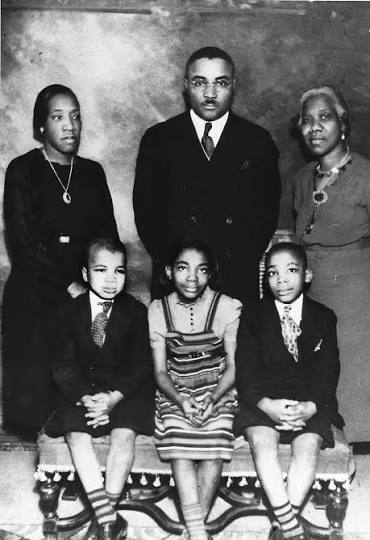
Project for the Beloved Community, Incorporated , founded in 1999 as MDB Ministries, Inc., is a Christian-based, nonprofit corporation that is devoted to promoting justice interpreting individual and social ethics in our society and world, and helping organizations and individuals in need of financial assistance. Whereas it is not formally a 501(c)(3) with a determination letter, it is classified as a type of church or auxiliary of a church that is automatically tax-exempt. As such, it is considered to be a 501(c)(3) organization by default and must adhere to IRS regulations, such as not engaging in political campaigns and limiting lobbying. While it is exempt from filing Form 990, donations to it are tax-deductible. At the state level, it is considered a nonprofit corporation.
If you feel compelled to make a charitable contribution to donate to the Project, you can do so by sending your contribution via PayPal (mdbwell@yahoo.com), or CashApp ($peacenik55), or Venmo (mdbwell@yahoo.com). Make sure to put “Project” in the memo. Thank you.

 DoctorB's Social Ethics Blog