
At the end of the First World War, analysis of the state of human affairs reverberated in social clubs, academic lecture halls, political assemblies, and religious institutions. One individual, who began formulating his responses to war’s massive devastation and dislocation, was (Karl Paul) Reinhold Niebuhr (6-21-1892 to 6-1-1971).
Initially, Niebuhr was in favor of entrance into the global crisis by the United States. However, after the conflagration, he began to rethink his socioeconomic and political perspectives. A few years after the passing of the popularizer of the Social Gospel Movement, Walter Rauschenbusch (1861-1918), Niebuhr began to reshape his Christian understanding of the kingdom of God as a solely apocalyptic, otherworldly destination and view of Jesus only as a substitution for humans’ deserved punishment for their sins, but rather as a revolutionary who emphasized empathy for and activist advocacy towards those struggling in present society. Niebuhr attended Eden Theological Seminary from 1910 to 1913, in Webster Groves near St. Louis. Upon his graduation and the death of his father, Gustav, he took over as interim pastor of his father’s German Evangelical Church in Wright City, Missouri, a precursor to the United Church of Christ, because of his father’s death. He remained in that position only momentarily, for he went on to matriculate at Yale Divinity School, where he earned his Bachelor of Divinity degree in 1914 and subsequently his Master of Arts degree in 1915. After graduating from Yale, Niebuhr became an ordained minister and became the pastor of the Bethel Evangelical Church in Detroit, Michigan.
Responding to the violence of warfare and embracing the social gospel, Niebuhr began to shift his hawkish political stance to the an antiwar, pacifist faith and his unexamined capitalist heritage to a socialist framework in support of industrial laborers. By the early 1930s, Niebuhr had been a committed advocate of and worker for these positions. However, as the Great Depression wreaked havoc upon the masses and the scourge of fascism was spreading through Europe and elsewhere, he again commenced to alter his ideological stances. He had become an ardent antiwar optimist, having joined the pacifist organization, the Fellowship of Reconciliation (FOR), at one point becoming its national chairperson. In addition, in 1932, he ran unsuccessfully for the U.S. Congress under the Socialist Party banner.
Niebuhr broke away from the FOR in 1933, after having published his 1932 seminal work called Moral Man and Immoral Society. He began to emphasize that in the face of human immorality and sin, coercion was sometimes necessary, including warfare, to deal with recalcitrant international conflict and offensive violence. Hence, he absconded from liberal pacifism—becoming a prominent critic of his former position—and an ardent supporter of U.S. military participation in World War II.
Myles Horton (7-9-1905 to 1-19-1990) was born in Savannah, Tennessee, to a poor couple, Elsie and Perry Horton, who were forced out of their jobs as educators when the state began to require a high school diploma, which neither of them had. Eventually, they became sharecroppers, but challenged the notion of being “lower class,” and raised their children well: encouraging them to advocate for and help the indigent as devout Christians. Myles left home at 15 to attend high school, and worked at a sawmill to support himself. While working, he became familiar with the plight of laborers. He also encouraged a strike for higher wages at a tomato factory where he was employed. He attended Cumberland University in 1824 as he also worked with labor unions and as a state secretary for the Student YMCA. In the late 1920s, Horton began studies at Union Theological Seminary in New York, where Niebuhr had become a new faculty member in 1928. He theological and ethical perspectives were greatly informed and enriched by Niebuhr’s emergent radical sociopolitical philosophy and impassioned advocacy for the poor.
When Horton visited and studied in Denmark, he learned more about the country’s development of folk schools. They were residential adult education centers that fostered community, equality, and lifelong love of learning through activities such as singing, discussions, and shared living—providing a unique, holistic education primarily for young adults. There were no entrance exams, grades, or formal diplomas; the learning was driven by personal interest and intrinsic motivation, not external rewards. They were Christian-based, and promoted Denmark’s democratic transition and a strong rural civilization.
After returning from Danish country, Horton broached his idea of starting a folk school back home with Niebuhr. His professor supported the concept, and helped him raise the funds to co-found the Highlander Folk School in 1932. The school’s original purpose, as stated in its mission, was “to provide an educational center in the South for the training of rural and industrial leaders, and for the conservation and enrichment of the indigenous cultural values of [the Appalachian] the mountains [region].” Niebuhr actually supported the school for decades—even when it lost its charter in 1961!
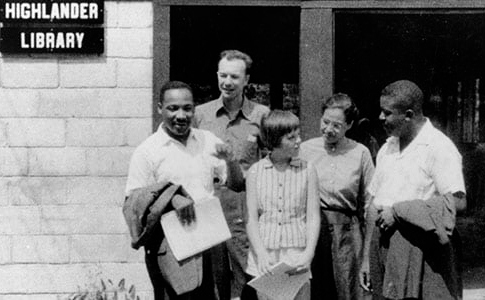
The educational formulation was to create engaged citizens, provide personal transformation, and build a foundation for a just and democratic society, often serving as a life-changing break from traditional education. The Highlander Folk School was a crucial training ground and incubator for the Civil Rights Movement, providing integrated education, leadership development, and a physical space for activists, where they developed strategies, learned nonviolent protest, and established Citizenship Schools to teach literacy for voter registration, empowering Black communities to fight segregation and disenfranchisement. It also worked on labor organizing and desegregation workshops, and even indulging in singing protest songs such as “We Shall Overcome.”
The school became a vital, though controversial, center for social change. It empowered grassroots activists with the tools and confidence to challenge racial injustice; hosted early meetings for the Student Nonviolent Coordinating Committee (SNCC) and trained many of its members, including the inimitable leader, Ella Baker. After the state shut down the school, the school reopened as the Highlander Research and Education Center. It was instrumental in influencing and assisting major civil rights leaders, including Martin Luther King Jr., Rosa Parks, John Lewis, Ralph Abernathy, Marion Barry, and James Bevel. It provided integrated training in nonviolent resistance, organizing, and leadership that undergirded the movement’s strategies, with Parks’ experience at Highlander—along with her work as secretary of the Montgomery branch of the NAACP—inspiring her pivotal role in the Montgomery Bus Boycott and beyond.
Today, the Highlander Research and Education Center, a social justice leadership training school in New Market, Tennessee, northeast of its second location in Knoxville, continues the folk school legacy of education and organizing for nonviolent social change. In the early 1960s, Horton transferred the leadership of the successful Citizenship Schools program to the Southern Christian Leadership Conference (SCLC) to focus on new challenges. Throughout the 1960s and 1970s, Horton turned his attention toward the struggles of Appalachia, specifically addressing environmental problems such as strip-mining and toxic chemical dumping, as well as worker health initiatives for coal miners.
The school had helped to train Bob Moses, who was noted for his yeoman work in Mississippi and innovative mathematical instruction, and participating in the Poor People’s Campaign—erecting a tent complex at Resurrection City in Washington, D.C., following the assassination of Martin Luther King Jr. (4-4-1963). Horton himself officially retired as the director of Highlander in 1973, though he remained an active participant and influential voice in international popular education discussions. In 1990, shortly after his death, his autobiography, The Long Haul, was published, along with We Make the Road by Walking, a collection of conversations with Brazilian educator Paulo Freire, who is most noted for his book, Pedagogy of the Oppressed(1968/1970).

 DoctorB's Social Ethics Blog